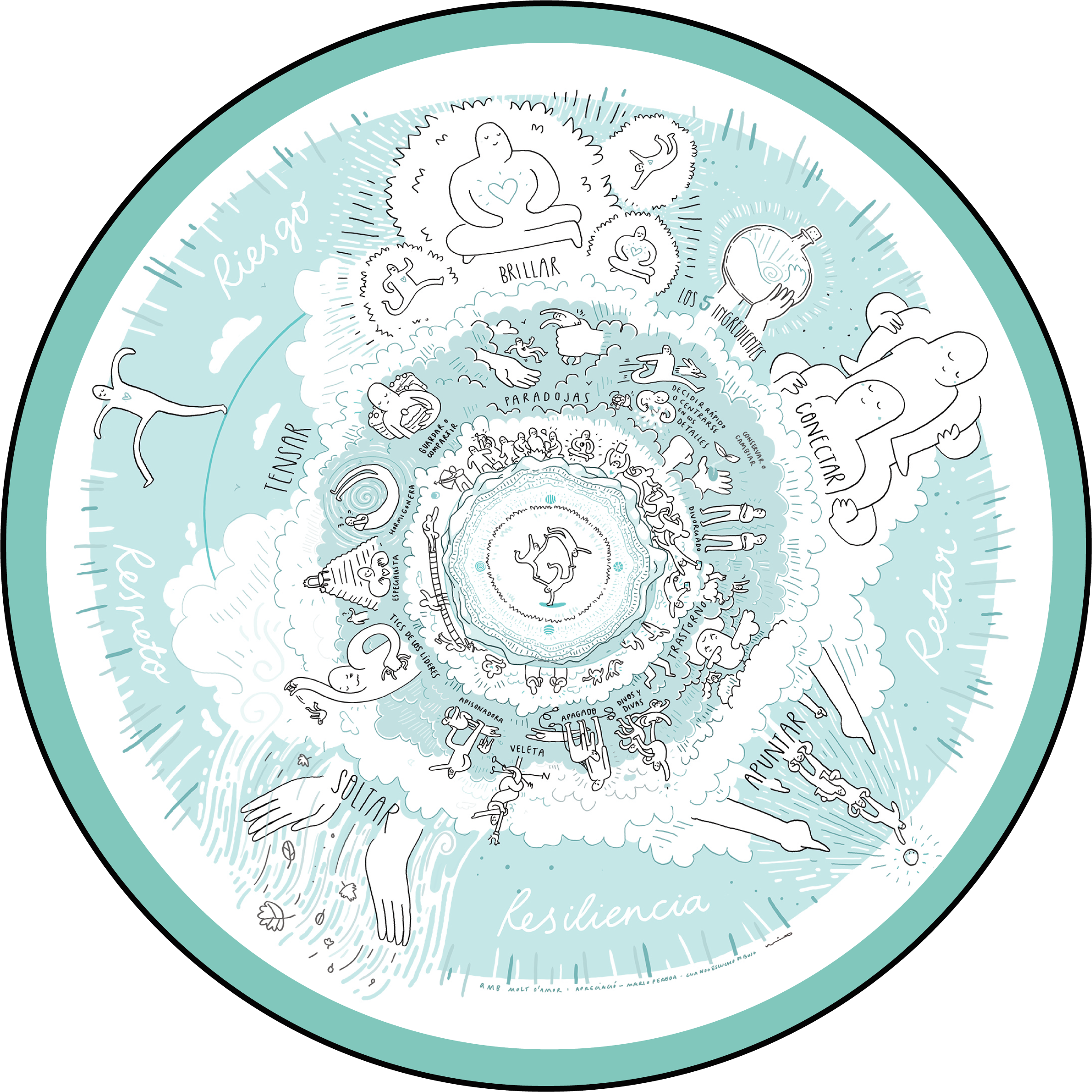
This template aims to provoke reflection within the team regarding the culture of demanding leadership within it .
Becoming aware of the mechanisms the team uses to creatively challenge its members will be a starting point for increasing value contribution within the organization , as well as increasing the maturity of relationships between its members.
The team's blood pressure monitor can be an instrument that facilitates this reflection, first individually and, later, at a group level.

This template aims to invite team members to reflect on how some of their beliefs and habits may be causing significant resistance to achieving the challenges set by the team itself.
Identifying everything that is essential or necessary to change will be the first step for the team to agree on a series of actions to let go of everything that is hindering progress.

With the aim of creating a leadership culture within the team that allows its members to shine and make each other shine, it is suggested to complete the following tool.
This template aims to support team members in taking shared responsibility for achieving their full potential . In this way, each member will be actively involved, through concrete actions, so that their colleagues have a more positive impact within the team and as members of the organization.

With the aim of helping the team define its vision , as well as its unique way of making its contribution , it is suggested to complete the following tool.
Based on Simon Sinek's Golden Circle model , this template aims to support the reflection process of team members in defining the specific contribution expected from the group , the way in which they wish to make their contribution , and the ultimate purpose of why they are making it .

With the aim of improving relationships between team members, it is recommended to complete the map of their connections .
This will allow for reflection on the current state of each of the relationships between the members, while also initiating pending conversations between them.

With the aim of reflecting on the impact that the leader has on the team , it is necessary to begin a diagnostic process that includes two phases :
or A personal diagnosis of the tics that the person believes they currently have when interacting with the team and the organization.
or An external diagnosis of its impact through the opinion of the people who work with him or her.
It is therefore a matter of deeply analyzing the leadership style from a personal perspective, as well as from the perspective of the people in the surrounding environment.
This assessment should be carried out by everyone on the team, not just the formal leader. It is essential, for the benefit of teams and companies in general, to maintain the conviction and belief that all members of any team are leaders, as they lead tasks, situations, and relationships.
So this exercise suggested in this template is intended to be done by anyone on the team, whether or not they have people reporting to them.

In practice, each extreme of a paradox pushes to gain more weight than the other, even though common sense tells us that we need to balance both needs to be productive. We even start to think that we have to choose only one of the two, since, as we remind each other, we can't have our cake and eat it too. But in most cases, the solution lies in learning to integrate and combine instead of choosing one extreme and discarding the other.

To address a team's main problems, it's essential that all members actively participate in finding solutions to minimize the negative consequences of these problems . A very effective way to begin is by conducting a shared assessment of the team's current situation .